New Jack Swing: The Sound That Fused R&B and Hip-Hop
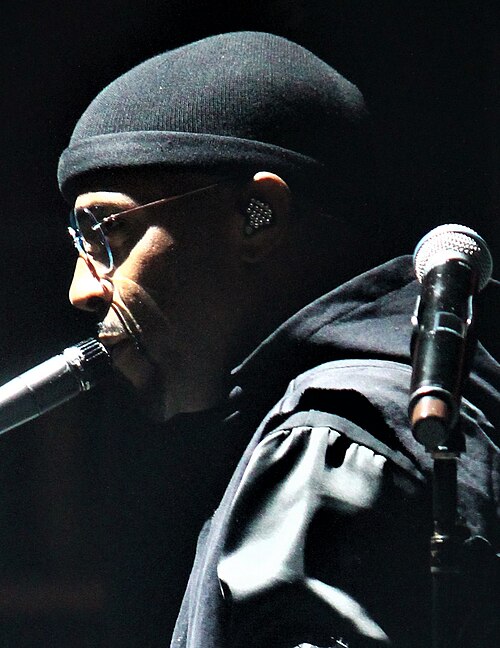
A limo pulling in from the airport, the dial getting flipped station to station, and the same producer's sound coming back on all three. That's the moment Teddy Riley says made him realize what he'd built in a Harlem club basement had stopped being a local thing. It had become a whole genre, and someone else had already given it a name.
New jack swing is the late-1980s genre that fused hip-hop's drum-machine rhythm programming with traditional R&B vocal performance, built mainly out of Teddy Riley's Harlem studio work and named by Village Voice writer Barry Michael Cooper in a 1987 profile. Between 1986 and 1989 it went from a Harlem-specific sound to the production style running under a large share of what urban contemporary and crossover pop radio played at once, carried by Riley's work with Guy, Keith Sweat, and Bobby Brown.
Where the name came from
A genre needs a name before people can talk about it as one. New jack swing got its name from journalist Barry Michael Cooper, in an October 18, 1987, Village Voice profile of Teddy Riley titled "Teddy Riley's New Jack Swing: Harlem Gangsters Raise a Genius." Cooper combined "new jack," street slang for a newcomer used earlier by Grandmaster Caz of the Cold Crush Brothers, with "swing," drawing a deliberate analogy between Fitzgerald-era speakeasy music and the sound coming out of what Cooper described as Teddy Riley's crack-era Harlem. Cooper was born June 12, 1958, in Harlem, and worked as a Village Voice critic and investigative reporter from 1980 to 1989. Four years after naming the genre, he wrote the screenplay for the unrelated 1991 crime film New Jack City, which shares half its title by coincidence of language alone. Teddy Riley's brother Markell described the pre-name period plainly: the sound was floating around Harlem in cars, known locally, before Cooper's piece turned it into a genre with a name journalists, programmers, and labels could all point at. Cooper died January 22, 2025.
The Harlem producer at the center of it
Edward Theodore Riley was born October 8, 1967, in Manhattan and raised in the St. Nicholas Houses in Harlem. His uncle owned the Harlem club The Rooftop and built a recording studio inside it, and Riley grew up in that room. At 18 he produced Kool Moe Dee's "Go See the Doctor" (1986), which reached number 89 on the Hot 100. AllMusic credits him as the architect of new jack swing, and Uptown Records founder Andre Harrell called him "the inventor of the sound." Riley describes his own contribution more simply: "I define the term [new jack swing] as a new kid on the block who's swinging it."
That outsized role shouldn't be flattened into a sole-inventor story, though. Wikipedia's own genre-definition article names four producers as spearheading new jack swing together: Riley, Bernard Belle, Jimmy Jam and Terry Lewis, and Dallas Austin. Jimmy Jam and Terry Lewis built their own production line alongside Riley's, a separate story worth reading on its own, one that also connects to Janet Jackson's crossover run later in the decade. Riley built and popularized the style that made the genre commercially real, and he wasn't the only producer the genre's own reference sources credit with shaping it.
Guy: the album that proved it could carry a full record
In 1987, Riley formed Guy with Aaron Hall and Timmy Gatling. Their self-titled debut came out June 14, 1988, on Uptown Records, peaked at number 27 on the Billboard 200, and was certified double platinum by the RIAA in July 1994. It was the proof-of-concept the genre needed: this sound could sustain a full album. The group's own history carries a rough patch worth stating plainly. Manager Gene Griffin forced Timmy Gatling out after Gatling refused to sign a management contract that gave Griffin control of the group's publishing and income; Gatling was replaced by Aaron Hall's younger brother, Damion Hall.
The record that gave the sound its first hit
Keith Sweat, born July 22, 1961, in Harlem, pursued fellow Harlem resident Teddy Riley to produce his 1987 debut, Make It Last Forever. Riley had the beat and background vocals for "I Want Her" prepared before Sweat was ever involved in the sessions, then encouraged Sweat's nasal vocal delivery specifically to set him apart from other R&B singers of the period. "I Want Her" reached number 5 on the Billboard Hot 100 and spent three weeks at number one on the R&B chart. Wikipedia's genre article states it directly: "It is considered the first new jack swing hit," a characterization the source itself makes.
Radio starts playing one producer everywhere at once
By 1988 and 1989, new jack swing wasn't one hit record. It was one producer's sound repeating across a dozen different artists on urban contemporary and crossover radio at the same time. Engineer and producer Prince Charles Alexander, who spent his own studio time trying to work out how Riley built those drum patterns, put it plainly: if a listener heard 15 songs on the radio in that stretch, almost all 15 were produced by Teddy Riley. Riley experienced that density directly, describing coming home from a trip: "I thought my record was just playing on WBLS and KISS and WKTU... you go to the city, and you hear your record on the radio, while you're in the limo, coming from the airport." WBLS and Kiss FM were the city's dominant urban outlets in those years; the WKTU call letters Riley mentions had left the air in 1985 and did not return to New York radio until 1996. The chart most of these records were climbing carried its own specific name in this window: Billboard's R&B singles chart was called "Hot Black Singles" from late June 1982 until it reverted to "Hot R&B Singles" on October 27, 1990. How New Jack Swing Took Over Urban Radio tells the fuller version of this story.
Bobby Brown: the track that turned a solo act into a phenomenon
Bobby Brown's second album, Don't Be Cruel (1988), made him a star mostly on the strength of Antonio "L.A." Reid and Kenneth "Babyface" Edmonds' polished R&B production, following Brown's firing from New Edition. But "My Prerogative," the one track Teddy Riley touched, is what turned Brown from a successful solo act into the era's biggest new name. Riley's own album credit runs keyboards, mixing, and background vocals, not producer; the track was produced by Gene Griffin and Brown himself, written by all three, after Brown and Griffin flew back to New York specifically to cut one more song once the rest of the album was already finished in Los Angeles. Brown wrote it as a direct response to his own firing: "A lot of things had been said about Bobby Brown, why was he doing this, a solo career. It's my way of expressing to people it's your prerogative to do as you want." The song went from number 78 on the Hot 100 in October 1988 to number one on January 14, 1989. Hank Shocklee of the Bomb Squad summed up the sequence for the Red Bull Music Academy oral history: "Bobby Brown's record started off with 'Don't Be Cruel,' which was L.A. Reid. It didn't really blow up until Teddy Riley got to it with 'My Prerogative.'"
A second production line, running in parallel
Not every act in this window ran through Riley's Harlem circle. Reid and Babyface built a separate late-1980s run for Karyn White, Pebbles, and The Boys, years before they founded LaFace Records in 1989. It's a smoother, more conventionally R&B sound than Riley's harder, hip-hop-inflected records, and proof the era's story runs wider than one producer's circle.
The songs that carried it, one by one
A handful of individual records did the actual work of getting this sound played next to the biggest pop stars of the decade. "My Prerogative" is covered in full detail on its own page, including its chart run to number two on the Billboard Year-End Hot 100 for 1989 and its later cover by Britney Spears. "I Want Her" gets the same treatment, tracing exactly how Riley built the track before Sweat ever walked into the room. And Al B. Sure!'s "Nite and Day", a 1988 hit he wrote and produced himself with Kyle West, reached number 7 on the Hot 100 and topped the R&B chart, earning a Grammy nomination along the way; West's own recollection of first hearing Riley's sound in 1985 is a useful marker of the genre's earliest stirrings, kept separate from "Nite and Day" itself, which came three years later.
New jack swing beyond one producer
New jack swing isn't a clean, one-producer origin story, even though Riley's own outsized role makes it tempting to tell it that way. A journalist named it after the fact, a manager forced a founding member out of the genre's own flagship group over publishing money, and the genre's own reference sources credit at least three other producers alongside Riley for building it. None of that changes what the records actually did: they got hip-hop's rhythm programming and R&B's vocal performance played on the same station, back to back, without a seam, and that combination reshaped what urban and pop radio sounded like for the rest of the decade.
FAQ
What is new jack swing? New jack swing is a late-1980s genre that fuses hip-hop drum-machine rhythm programming with traditional R&B vocal performance, built mainly out of Teddy Riley's Harlem studio work between 1986 and 1989.
Who invented new jack swing? Teddy Riley is the producer most sources credit as the genre's architect, but Wikipedia's own genre article names three other producers, Bernard Belle, Jimmy Jam and Terry Lewis, and Dallas Austin, as spearheading the sound alongside him.
Where does the name "new jack swing" come from? Village Voice writer Barry Michael Cooper coined it in an October 18, 1987, profile of Teddy Riley, combining "new jack" (street slang for a newcomer) with "swing" (a reference to swing-era jazz).
What was the first new jack swing hit? Wikipedia's genre article calls Keith Sweat's 1987 single "I Want Her," produced by Teddy Riley, the first new jack swing hit, based on its number 5 Hot 100 peak and three-week run atop the R&B chart.
How did new jack swing take over the radio? By 1988 and 1989, Teddy Riley's production was so widespread that engineer Prince Charles Alexander estimated almost all of every 15 songs heard on the radio in that stretch were his. The sound played on both urban contemporary and crossover pop stations at once.
Was every late-80s R&B hit part of Teddy Riley's circle? No. Antonio "L.A." Reid and Kenneth "Babyface" Edmonds ran a separate production line for Karyn White, Pebbles, and The Boys during the same years, before founding LaFace Records in 1989.
An all-80s stream from the Bubble is on the way. Part of 80s Radio, the story of how DJs and clubs shaped what the decade actually heard. See also Freestyle and Hi-NRG, the club sounds that grew up alongside it.