Freestyle · The Sound the Clubs Built and the Radio Couldn't Ignore
Before freestyle had a name, it had a room: a club packed past midnight, a DJ working two copies of the same record, and a drum machine doing something disco never did. Years before any of it reached a car radio, freestyle had already been road-tested on dance floors in New York that most listeners never saw. By the time it broke through, it had become one of the few genres of the decade that Top 40 radio didn't invent. It just eventually caught up to it.
Freestyle is an electronic dance genre that grew out of Puerto Rican and Italian American club scenes in New York City in the early 1980s, then developed a second, poppier strand in Miami. It fuses the synthetic drum-machine beats and syncopated percussion of early electro with Latin American rhythms and yearning, romantic vocals. Shannon's 1983 single "Let the Music Play" is often called the genre's first hit, and by 1987 freestyle records were crossing over onto mainstream pop radio nationwide.
Where it came from
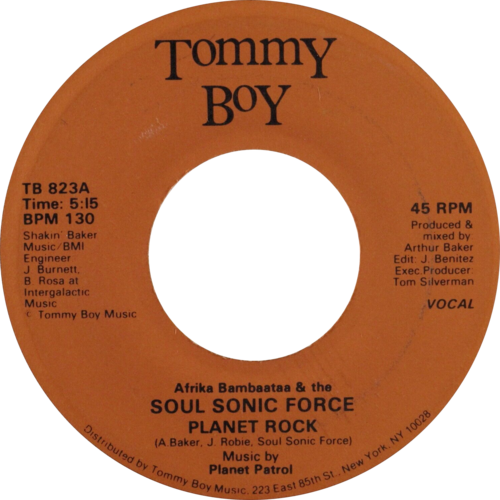
Freestyle developed simultaneously in the Hispanic communities of Upper Manhattan, Brooklyn, and the Bronx, and in the Italian American communities of Brooklyn, the Bronx, New Jersey, Westchester County, and Long Island. It started as a fusion of the synthetic instrumentation and syncopated percussion of early 1980s electro, the sound breakdancers favored, folded together with the sampling techniques coming out of synth-pop and hip-hop. Afrika Bambaataa and Soul Sonic Force's "Planet Rock" (1982) is the genre's most important precursor. A year later, Shannon's "Let the Music Play" became a top-ten Billboard Hot 100 hit and is widely credited as freestyle's true starting point, a claim strong enough that critics still call the record's sound "The Shannon Sound." In 1984, Nayobe's "Please Don't Go" became the first freestyle record by a Latin American artist to break through, reaching number 23 on the Billboard Hot Dance Music/Club Play chart. Radio airplay followed through the mid-1980s, city by city, well behind the clubs.
The New York club that ran ahead of the radio
New York's freestyle scene was built inside its nightclubs before it ever needed a radio format. The Fun House and Jellybean Benitez tells the story of the West 26th Street club where Benitez held residency from 1981 to 1984 and turned a dance floor into a genre's testing ground, the same club Madonna is said to have haunted while trying to get discovered. Once a record worked at the Fun House or a club like it, it still had to reach the people who couldn't get in. The Latin Rascals and the Megamix You Taped Off the Radio picks up from there: Albert Cabrera and Tony Moran spliced hit records together by hand on reel-to-reel tape for WKTU and 98.7 Kiss FM, turning a night's worth of club records into a few minutes of radio that listeners recorded off the air.
Miami built the version that crossed over
Miami's freestyle sound ran parallel to New York's and eventually outpaced it on the pop charts. Exposé: The Miami Group Lewis Martineé Built From Scratch covers the producer behind the sound, and the two different lineups of singers who carried his songs four years apart. Point of No Return: The 12-Inch That Became Exposé follows one of those songs specifically, a 1985 club single that got re-recorded by a different trio in 1987 and became a top-five pop hit the second time around. The pattern repeats across the format: labels leaned on Miami's polished, Top 40-ready freestyle records more heavily than New York's rawer club sound, and it is a large part of why Miami acts crossed over biggest and stayed on the radio longest.
The songs that carried it onto the radio
A handful of records did the actual work of getting freestyle played next to Michael Jackson and Madonna on the same station. Lisa Lisa and Cult Jam: The Teenager Full Force Found follows a Hell's Kitchen teenager who fronted one of freestyle's biggest crossover acts, and I Wonder If I Take You Home: Lisa Lisa's First Shot traces that group's breakout single from a discard bin at a small label to number one on the dance chart. Shannon: The Record That Opened Freestyle Radio goes back to the record most historians point to as the one that started it all.
Where it went
Freestyle's Top 40 airplay grew fast by 1987, carried by records like "Come Go with Me," "Show Me," "Fascinated," "Silent Morning," and "Catch Me (I'm Falling)." It began disappearing from the airwaves in the early 1990s as stations moved to Top 40-only formats and house music, new jack swing, and mainstream pop pushed it out. The genre kept resurfacing anyway. New York impresario Steve Sylvester and producer Sal Abbatiello put on a freestyle revival show at a Manhattan venue in 2004, a 2006 concert at Madison Square Garden showcased the genre's biggest names, and in March 2013 a freestyle bill at Radio City Music Hall sold out so fast a second night got added within days. Freestyle's reach went past its own clubs, too: the Latin Rascals remixed Duran Duran's "Notorious," and Miami producer Lewis Martineé produced the Pet Shop Boys' "Domino Dancing," proof the sound traveled well past the rooms that built it. An all-80s stream from the Bubble is coming, and freestyle is part of the sound it carries forward.
What freestyle left behind
Freestyle wasn't a single sound wearing one name. It was a New York club sound and a Miami pop sound running side by side, built by producers and DJs the labels often didn't know how to market, and it faded fast once radio moved on to the next trend. Plenty of it was formula, a drum machine pattern and a yearning vocal repeated across dozens of records chasing the same dance floor. But the songs that broke through did something real. They put Puerto Rican and Italian American kids from New York and Miami clubs on the same Top 40 stations as the biggest pop stars of the decade, and the sound still fills a dance floor and sells out a room, decades later.
FAQ
What is freestyle music? Freestyle is an electronic dance genre that emerged in the early 1980s New York club scene, built by Puerto Rican and Italian American DJs and producers from electro drum machines, Latin percussion, and romantic pop vocals. A second, poppier strand developed in Miami and eventually crossed over onto mainstream Top 40 radio.
What is Latin freestyle? Latin freestyle is another name for the same genre, reflecting its roots mainly in New York's Puerto Rican and broader Latin communities. It is sometimes also called Latin hip-hop.
Did freestyle start in New York or Miami? New York. The genre developed there in the early 1980s, in clubs like the Fun House. Miami built its own version of the sound afterward, one that leaned poppier and eventually had more Top 40 crossover success.
Is freestyle music the same as house music? No. Freestyle and house developed alongside each other, but freestyle grew out of electro and hip-hop's drum-machine sound with sung, romantic vocals, while house grew more directly out of disco's four-on-the-floor rhythm. House began pushing freestyle out of clubs and off the radio by the early 1990s.
What was the first freestyle song? Shannon's "Let the Music Play" (1983) is the record most often credited as freestyle's first hit, though Afrika Bambaataa and Soul Sonic Force's "Planet Rock" (1982) is considered an important earlier precursor to the sound.
Why did freestyle disappear from the radio? Stations began moving to Top 40-only formats in the early 1990s, and newer sounds like house, new jack swing, and mainstream pop pushed freestyle out of rotation. It never fully vanished, because revival shows and concerts through the 2000s and 2010s, including a Radio City Music Hall bill that sold out two nights in 2013, kept the genre alive for its original audience.
Part of 80s Radio, the story of how DJs and clubs shaped what the decade actually heard. See also Stories Behind the Songs.